Blogs
A Teacher’s Perspective: What Students Often Don’t Realize About Teaching
Teaching is often seen from the outside as simply delivering lessons and grading assignments. However, there is much more to it than visible. Behind every class there is careful planning, emotional investment and a deep commitment to student’s growth.
Students see the hour spent in class, but teachers spend many more hours preparing lessons, creating materials and thinking of ways to make learning engaging and meaningful.
Teachers don’t just teach subjects, they teach individuals. They notice when a student is unusually quiet, struggling or excelling. They celebrate progress, no matter how small and they genuinely care about each student’s journey.
Teachers value effort, improvement and curiosity even more. A student who tries, asks questions and stays engaged leaves a lasting impression.
Rules and discipline are not about control, they exist to create a safe and productive learning environment.
Teaching is not just an intellectual task, it is deeply emotional. Teachers feel proud when students succeed and feel concerned when they struggle. Their role extends beyond academics to mentorship and guidance.
Teaching is more than a profession, it is a commitment to shaping lives. Understanding a teacher’s perspective can help students build stronger relationships, appreciate the effort behind their education, and create a more positive learning environment for everyone.

Mrs. Rajani Nair
Supervisor
SSPM Day School & Junior College
Time Dilation: The Warping of Time
Imagine two twins. One blasts off into space at nearly the speed of light, while the other stays on Earth. When the space-travelling twin returns years later, they’ve aged only a few months, while their Earth-bound sibling is decades older. This isn’t science fiction. It’s the mind-bending reality of time dilation, a cornerstone of Einstein’s theory of relativity.
What is Time Dilation?
Time dilation is the phenomenon in which time passes at different rates for observers in various states of motion or in different gravitational fields. Simply say, time doesn’t tick the same way everywhere.
There are mainly two types:
1) Speed-induced time dilation: The faster you move, the slower time passes relative to a stationary observer.
2) Gravity-induced time dilation: The stronger the gravitational field, the slower time passes.
The Science behind this is Einstein’s theory of special relativity in 1905, which introduced speed-induced time dilation. Later, general relativity in 1915 expanded this idea by showing how gravity also affects time.
Real-life examples:
1) GPS satellites must adjust their onboard clocks for time dilation caused by both speed and gravity. Without this correction, navigation systems would quickly become inaccurate.
2) Particle accelerators provide another proof. Particles moving close to the speed of light experience time dilation, confirming Einstein’s predictions.
3) Astronomical observations also reveal time dilation, especially when observing light from distant and massive cosmic objects.
Implications:
1) For space travel, astronauts age slightly less than people on Earth due to time dilation.
2) The famous twin paradox highlights the strange and fascinating consequences of this effect.
Time dilation shows that our everyday experience of time isn’t absolute. It can bend and stretch, revealing just how surprising and beautiful the nature of reality truly is.

Mrs. Aparna Jare
(Assistant Teacher)
Empowering Young Minds: The Story Behind SSPM Day School and Junior College’s Legacy of Learning
In today’s rapidly evolving world, education is more than just academics — it’s the foundation that shapes future leaders, innovators, and compassionate citizens. At AISSM’s SSPM Day School and Junior College, this philosophy is at the core of everything we do. Guided by the motto “Empowering Young Minds,” we are dedicated to fostering holistic development in our students — intellectually, socially, emotionally, and physically.
A Legacy Rooted in Vision
Our institution draws inspiration from Rajarshi Chhatrapati Shahu Maharaj, a pioneering force in social reform and inclusive education. Carrying forward his legacy, the AISSMS group of institutions has proudly served society through quality education for over five decades.
In 1991-92, building upon the strong foundation of SSPM Day School, the Junior College wing was established. Since then, it has grown into a nurturing space for young learners ready to take on the challenges of higher education and the real world. Whether it’s through our upgraded infrastructure, engaging curriculum, or community-driven initiatives, we are committed to shaping not just successful students, but well-rounded individuals.
At SSPM Day School and Junior College, learning is not confined to classrooms. It lives in debates, competitions, sports fields, and even in the quiet moments of *service — like planting a tree or visiting an old age home.*
When we say “Empowering Young Minds,” we mean creating leaders, dreamers, and doers who carry the spirit of excellence wherever they go.
What Makes SSPM Day School and Junior College Stand Out?
Established Legacy: Over 50 years of educational excellence, inspired by the reformist ideals of Rajarshi Chhatrapati Shahu Maharaj.
Two Streams: State Board curriculum for Science (160 seats) and Commerce (80 seats).
Modern Facilities: Sports grounds, tech-enabled classrooms, and round-the-clock security.
Dedicated Faculty: Teachers who mentor beyond the syllabus.
Enriching Activities: Quizzes, debates, exhibitions, career counseling, and more.
Community Engagement:* E-waste drives, environmental efforts, and outreach programs.
Recognized Success: Winners of 2024-25 Treasure Hunt at H.V. Desai College.
Notable Alumni: Leaders in engineering, medicine, defence, and public service.
Join us in building the future of tomorrow, today.
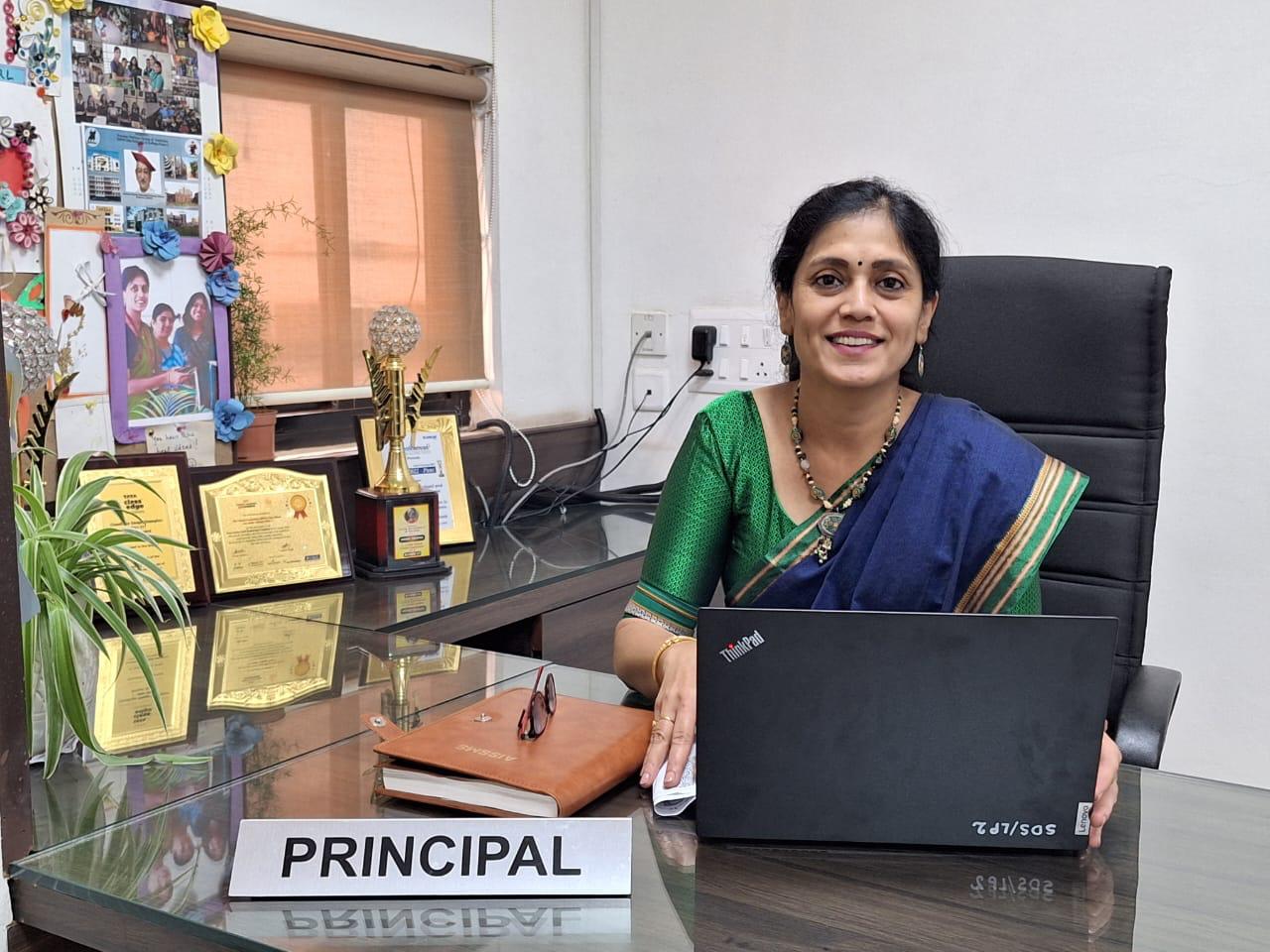
Ms. Shivaji Jagtap,
Principal, SSPM Day School and Junior College